Customer story
How a Moving Company Stopped Cleaning Up Duplicate Pipedrive Leads by Hand Every Day, with Dedupely
- Pipedrive
- After a list import
- Form fills and sign-ups
- Real estate

- 2,000+ duplicate records merged
- 1,000 matches merged
- 42,324 records synced to Dedupely
A match is one set of duplicate records merged into a single record. Every match holds at least two records, so the number of records merged is at least double the number of matches.
Where duplicates came from
Two lead streams that never checked each other
The company finds new customers in homes that are listed for sale, coming soon or pending: those homeowners are likely to move soon. Every day, about 200 of these listings are imported into Pipedrive as Leads. At the same time, people who fill in a web form or call in arrive as Leads through an automation.
The duplicates came from the gap between the two:
- Imports and web forms didn't check each other. Pipedrive caught duplicates inside an import, but not between an imported listing and a lead that came in through the website.
- The same home, imported twice. When a listing changed from for sale to pending, the next import created a second lead for the same home.
- People already in Pipedrive came back. Someone imported as a listing, or already a customer, could call or fill in a form and become a new lead. One person came in as four separate leads.

What duplicates broke
Cleanup by hand, every day
The company's owner, who runs the CRM herself, was cleaning up duplicates by hand and wanted it to run in the background instead. Some duplicates slipped through: in one case, a person who was already a deal still had an open lead that a rep was reaching out to.
The wrong owner after a merge
Merging in Pipedrive could make the wrong person the owner. A lead that came from an early list belonged to the rep who got it first, and a merge could hand it to someone else.
How duplicates were solved
-
1. Match on phone and email, not address alone
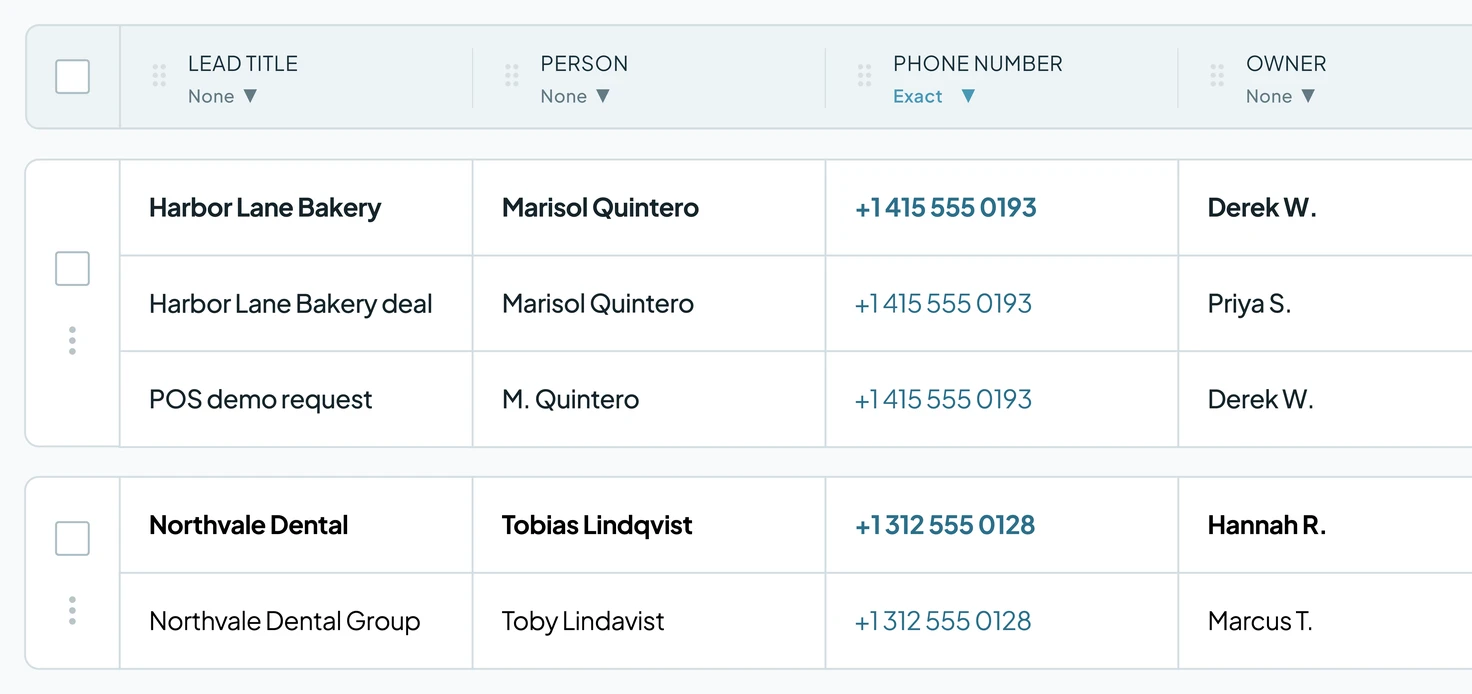
With Dedupely's customer success team, she tested Lead searches on her own data. A similar address found more than 1,100 matches, many of them different apartments in the same building. An exact phone number worked much better, and a cloned search on the person's email caught a duplicate the address search never would have: one person saved with two different apartment numbers.
-
2. Keep each lead with its rep
Merge Rules decide the owner. Her own name always loses as owner, so a merged lead stays with the rep instead of landing on her. On People, the owner of the oldest person record wins. The Primary Record is the oldest record, and emails and phone numbers from every record are added together, so none are lost. The merge preview shows the winning owner in bold before anything merges.
-
3. Leave partners who share a phone number alone
Partners often share a phone number or an email, and both need to stay findable when one of them calls about the move. So partners stay as separate People, the duplicate leads are merged instead, and pairs that aren't duplicates are rejected so they don't come back.
-
4. Put the repeat case on Auto Merge
Two Lead searches now run on Auto Merge, including the one that catches the most common duplicate: a listing imported again when its status changes. Those merge on their own, with the Merge Rules deciding the owner, so the daily cleanup no longer depends on her.
What deduplication changed
2,000+ duplicate records merged
The company has merged 1,000 matches, combining at least 2,000 duplicate records. Today, Dedupely syncs 42,324 records for the company.
Not many duplicates left
Early on, she said she couldn't believe how many more duplicates they had, in People and in Leads. By the latest call, customer success found there weren't many duplicates left.

- Customer story 3,000+ duplicate records mergedPipedrive SaaS
How a Wellness App Stopped Sales Reps from Calling the Same Prospect by Merging 3,000+ Duplicate Pipedrive Records with Dedupely
Read the story - Customer story 58,000+ duplicate records mergedPipedrive SaaS
How a SaaS Company Merged 58,000+ Duplicate Pipedrive Records Created by Its Migration from HubSpot, with Dedupely
Read the story - Customer story 20,000+ duplicate records mergedPipedrive SaaS
How an AI Phone Answering Company Stopped Hand-Checking Pipedrive and Merged 20,000+ Duplicate Records with Dedupely
Read the story