


TL;DR
- How to handle a global company's offices is a business decision before it's a CRM task.
- Some companies treat regional offices as independent customers; others treat them as one account.
- Adding city or country as an exact match keeps offices of one company apart.
- Agree on which owner survives before merging accounts that different regions work.
- Dedupely matches, merges or keeps global accounts apart, following the decision your company makes.
A global customer rarely lives in one CRM record. There's a record for the headquarters, one for each regional office, a few for local subsidiaries and some that nobody remembers creating.
They share a name and often a domain, so every duplicate search puts them together. Whether to merge them depends on a question the CRM can't answer. Does your company treat those offices as separate customers or as one?
In this post, you'll see why that decision comes first and who should make it. You'll also see how to keep offices apart or bring them together, and how to handle the owners on each record.
Why global accounts are hard to keep straight
A global company reaches your CRM through many doors. Each region's team creates the accounts it works. Forms and enrichment tools add more, and an acquisition can bring in a whole second set.
The records end up looking alike in the fields searches use:
- Names with local legal suffixes, like GmbH, Ltd. or S.A.
- Domains on country variants, like example.de and example.fr.
- Owners in different regions, each with their own deals.
- Addresses in different countries, or the headquarters address on every record.
Our post on how international data creates hidden duplicates covers the formatting side. This post is about the decision behind it.
Decide first: independent offices or one global company?
How to handle a global account is a bigger decision than the CRM. It touches who owns the relationship, how contracts and billing work, and how revenue is reported by region.
So before anyone builds a search, pin down how your company treats the offices of a global customer. Both answers are common. Some companies must keep every office separate, and others need them to become one account.
| Signal | Points to separate accounts | Points to one global account |
|---|---|---|
| Contracts | Each office signs its own | One global agreement |
| Billing | Each office pays its own invoices | Headquarters pays for everyone |
| Owners | Each region has its own rep | One global account manager |
| Reporting | Revenue is reported by region | Revenue is reported per customer |
| Buying | Offices buy on their own | Purchases go through a central team |
Who should make the call
Sales leadership, regional heads and whoever owns the CRM, often RevOps, need to agree. Finance often has a view too, since billing follows the account.
Write the answer down per type of company instead of per record. "Subsidiaries with their own contract stay separate" settles hundreds of sets at once.
What counts as a duplicate is case by case. The same two offices can be one account for your company and two for another.
If offices stay independent, keep them apart
When regional offices are separate customers, duplicates still exist inside each office. The goal is to merge those while keeping offices away from each other.
- Add a location field as an exact match. City or country, matched exactly, stops a search from pairing the Paris office with the Berlin one.
- Match on the full domain. A comparison that ignores country variants pairs example.de with example.fr, so only use it where offices may merge.
- Reject sets you're certain about. Once two offices are confirmed as separate, reject the match so it stops coming back.
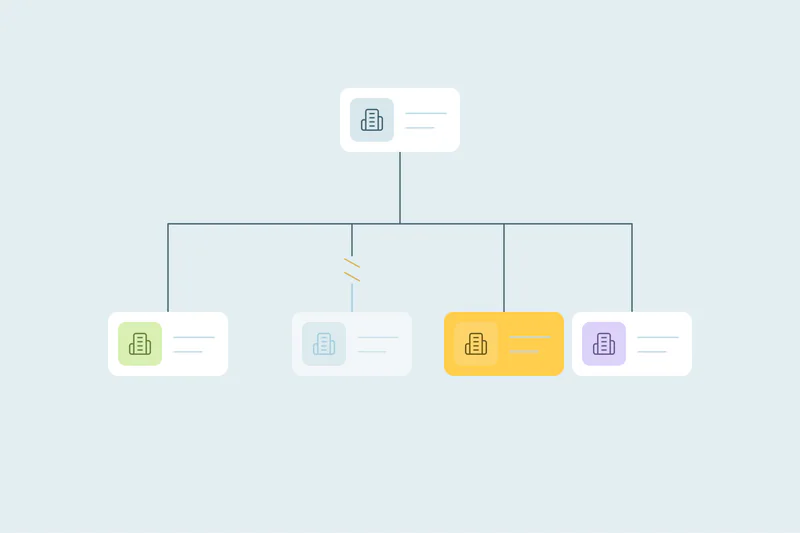
- Link the offices instead. A parent and child link shows the group structure without merging anything.
Our post on deduplication for multi-location businesses covers more ways to keep locations apart.
If it's one global company, bring the records together
When your company sells to the group as a whole, separate office records split one customer's history. Contacts, deals and activity sit under different accounts, and nobody sees the full relationship.
- Match on the core domain. A comparison that ignores country variants and "www" groups example.de, example.fr and example.com.
- Match names without legal suffixes. Leaving out terms like GmbH or Inc. lets local names match the global one.
- Choose the surviving record on purpose. The headquarters account, or the one integrations reference, is usually the right one to keep.
- Keep regional detail in fields. Region or country fields on contacts and deals keep local reporting working after the merge.
Many companies land in between. The global parent is one account, while some subsidiaries stay separate because they buy on their own. Treat each subsidiary by the same rule you wrote down, and keep the parent link.
Decide whose owner survives
Owners often cause the most disputes on global accounts. When two regional records merge, only one owner can stay, and the other rep can lose visibility of their deals.
Agree on the rule before the merge:
- The global account manager wins, if there is one.
- The owner of the headquarters record wins.
- The owner with open deals wins, and the others stay on the deals they own.
Tell the regional owners before their accounts merge. Our post on how lead routing and ownership rules create duplicates covers why owner conflicts start in the first place.
Send the close calls to someone who knows the region
Some sets won't fit your written rule. An office might have moved, or a subsidiary might have been sold. Send those sets to review, and ask the regional owner to confirm before anyone merges them.
Keep a list of the decisions as they're made. The next cleanup, or the next region, will raise the same questions.
How Dedupely helps you keep global accounts straight
In Dedupely, you can match city or country exactly to keep offices apart, or match on the core domain to group country variants. You can reject sets you're certain about, send close calls to review and set rules for which value wins, including the owner field. In Salesforce, a merge stops for accounts in the same parent–child hierarchy, and child accounts of a merged-away parent move to the surviving account.
Decide the structure, then clean the records
Global accounts show up as a matching problem. The hard part is a business decision. Until your company agrees whether regional offices are separate customers or one, every search result is a guess.
Once that's settled and written down, the CRM work follows from it. You keep offices apart with an exact location match or bring them together on the core domain. Then you agree on the owner before anything merges.
Frequently asked questions
Should regional offices be separate accounts in a CRM?
It depends on how your company works with them. If each office signs its own contract, pays its own invoices and has its own rep, keep separate accounts. If one global agreement covers them and one account manager owns the relationship, a single account usually works better.
Are subsidiaries duplicates of their parent company?
Usually not, when they buy and pay on their own. A subsidiary is often a separate customer that shares a brand and domain with its parent. Link it to the parent with a parent and child relationship instead of merging, unless your company treats the group as one account.
How do you stop a CRM from matching different offices of the same company?
Add a location field, like city or country, as an exact match in your duplicate search. Avoid comparisons that ignore country domains, since they pair example.de with example.fr. Once you're certain two offices are separate, reject the match so it doesn't come back.
Who should own a global account after a merge?
Agree on a rule before merging. Common choices are the global account manager, the owner of the headquarters record or the owner with open deals. Tell the regional owners first, and keep their deals assigned to them so they don't lose visibility of their work.
Who decides how to handle global accounts in a CRM?
Sales leadership, regional heads and the CRM owner, often RevOps, should decide together, with finance involved when billing changes. It's a decision about how the company sells and reports. Write the answer down per type of company, so it settles many duplicate sets at once.




 Or sign up with Google

 HubSpot Marketplace