

TL;DR
- Accented and unaccented spellings, like José and Jose, can split one person into two records.
- Names with two surnames get split into first and last name fields in different ways.
- The same phone number can be stored with or without its country code.
- Address formats differ by country, so addresses work better as supporting evidence for a match.
- Dedupely finds possible duplicates across name and phone formats, with a preview before merging.
A customer in Madrid fills in a form as "José García López." A rep in your US office adds him as "Jose Garcia." Your billing tool sends "GARCIA LOPEZ, JOSE" with his number in international format. To you, that's one person. To an exact match, it's three.
International data brings variation that many matching setups weren't built for. Characters change in exports, names follow different conventions and phone numbers carry country codes some of the time.
In this post, you'll see four sources of variation across nine countries: accents, name order, phone numbers and addresses. You'll also see how to match records without merging people who only look alike.
Why international records stop matching
Records come from forms, imports, reps, enrichment and other connected tools. Each source writes names, numbers and addresses its own way, and international data gives them more ways to differ.
- Characters: accents and letters like ñ, ü, ß or å are typed, dropped or replaced.
- Name order: two surnames and compound first names get split into fields differently.
- Phone numbers: the same number appears in national and international format.
- Addresses: the house number, postcode and city sit in a different order in each country.
Whether two of these records are duplicates is case by case. What one team considers a duplicate, another may not, so decide what counts as one person or company before you merge.
Accents and special characters
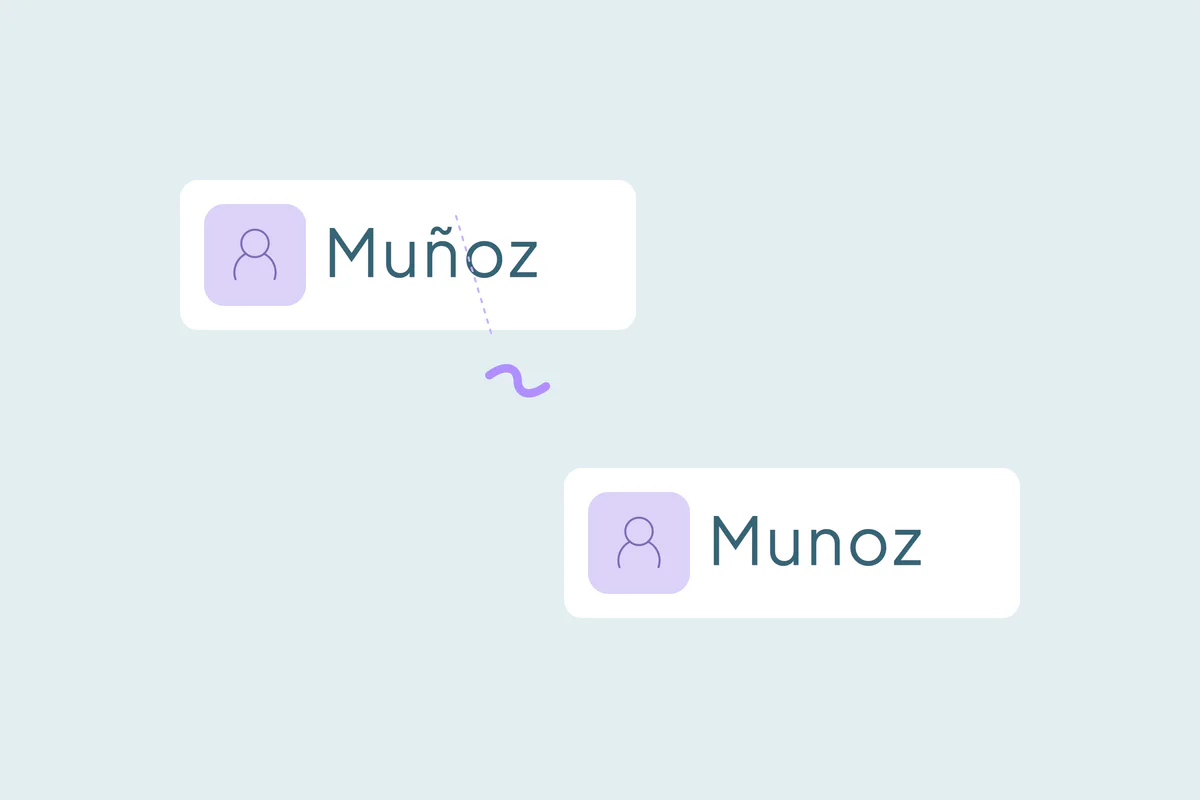
A person types their own name with accents. A rep on a US keyboard often leaves them out. An exact match compares character by character, so "José" and "Jose" are two different values.
Letters that get dropped or replaced
Each language adds its own set of letters. These are the ones that come up in the nine countries this post follows:
- Spanish: á, é, í, ó, ú and ñ, as in José or Muñoz.
- Portuguese: ã, õ and ç, as in João or Gonçalves.
- German: ä, ö, ü and ß, as in Müller or Strauß.
- Swedish: å, ä and ö, as in Åsa or Björk.
- Italian: à, è and ò, sometimes written as an apostrophe after the vowel.
Different ways to write the same letter
Dropping the accent isn't the only change. In German, when ü or ß isn't available, the convention is to write ue and ss. "Müller" can then appear as Müller, Mueller or Muller in three records.
Exports can also damage characters. When a file is saved in one character encoding and opened in another, "José" can come back as "José." Those records won't match anything until someone fixes them.
Name order and two surnames
CRMs usually store a first name and a last name. Many people's names don't fit that split neatly, and each source splits them its own way.
Spanish names
Spanish names usually have two surnames, the father's first surname followed by the mother's. In everyday use, many people go by only the first one. "José García López" can be stored with "García López" as the last name, or just "García."
Portugal and Brazil
Portuguese and Brazilian names can contain several surnames, and their order and everyday use vary. "Ana Costa Ferreira" may appear in a shortened form on another record. Do not infer identity or family relationships from surname order alone.
Compound first names
Compound first names, like "José Luis" or "Maria Fernanda," can end up partly in the last name field. A form with one "Full name" field makes this more likely, since something has to decide where to split.
Comparing the words two names share, in any order, catches many of these. It works best with a second field, like email or phone, because shared surnames are common.
Phone numbers and country codes
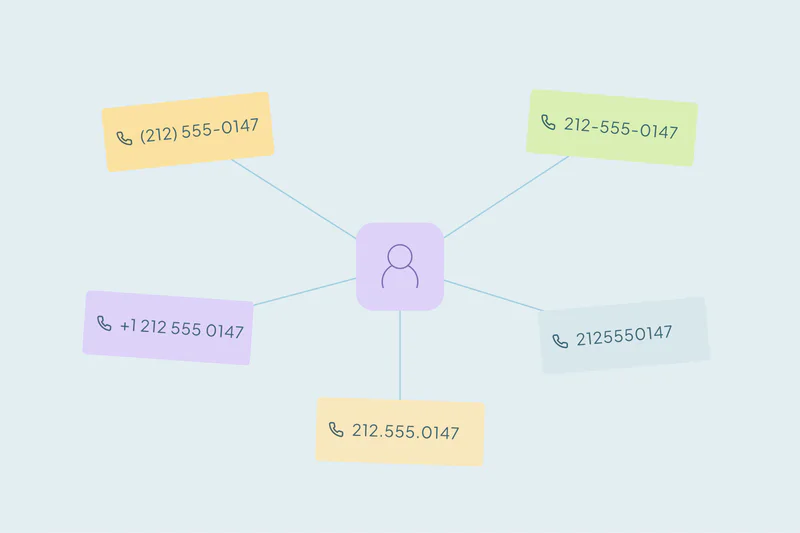
Phone numbers are a good matching field for international records, since they carry no accents and no name order. The problem is format. The same number can appear with a country code, without one, with spaces, dashes or brackets.
The international format starts with a plus sign and the country code, then the national number. The leading 0 also varies: in the UK, it's dropped after +44. In Italy, landline numbers keep it, so a Rome number starts +39 06.
What to watch for in nine countries
| Country | Calling code | Names | Phone and address notes |
|---|---|---|---|
| United States | +1 | Accents often dropped on entry | House number before the street name |
| Germany | +49 | ä, ö, ü and ß, also written ae, oe, ue and ss | Street, then house number; 5-digit postcode before the city |
| United Kingdom | +44 | Accents often dropped on entry | Leading 0 of phone numbers dropped after +44 |
| Italy | +39 | Accented vowels sometimes typed as an apostrophe | Landline numbers keep the leading 0 after +39 |
| Portugal | +351 | Several surnames; order can vary | Street, then number; 7-digit postcode written 0000-000 |
| Brazil | +55 | Several surnames; ã, õ and ç dropped or kept | Street, comma, number; 8-digit postcode written 00000-000 |
| Sweden | +46 | å, ä and ö dropped or kept | Street, then number; postcode written with a space, like 111 30 |
| Spain | +34 | Two surnames; á, é, ñ and others dropped or kept | Formats vary by source |
| Mexico | +52 | Two surnames are common | Formats vary by source |
Use the country table as a starting point, not a rule for every person or address. Check the relevant national numbering and postal guidance when normalizing data. The references below cover numbering plans, naming variation and US address conventions.
Address formats
In the US, the house number comes before the street. In Germany, Portugal, Brazil and Sweden, it comes after. Postcodes also differ in length, punctuation and position.
Abbreviations add more variation. "Rua" and "R.", "Straße" and "Str." or "Avenida" and "Av." are the same word, written two ways. On top of that, many records have no address at all.
That's why an address works better as supporting evidence. A postcode or city that agrees can raise your confidence in a name match. A long address that differs slightly says little.
Company names and domains across countries
Companies bring their own international variation. Legal suffixes such as GmbH, S.r.l. or S.A. de C.V. change by country, and we cover them in how company suffixes hide duplicates.
Country websites are another source. One business can use example.com, example.de and example.com.br. Removing a URL's path or www prefix does not make these different domains equal. Use a verified domain mapping and company details to identify related records, then decide whether the country entities stay separate.
How to match international records safely
The principles are the same as in any cleanup. International data just makes the second and third steps more important.
Start with the obvious duplicates
Exact emails and domains are useful candidate searches across naming formats. Check shared inboxes and separate country entities before merging, then review the harder name-based matches with independent details.
Compare names loosely, with a second field
Ignore accents, capitalization and word order when comparing names. Then require a second field to agree, such as phone, email or company. Read more on choosing which fields to match on.
Compare phone numbers by their digits
Normalize formatting while retaining country and extension information. Comparing the last digits can find candidates across formats, but unrelated numbers in different regions can share an ending. Confirm the full number and another identity field before merging.
Add country when entities should stay apart
Two people named Maria Silva in Portugal and Brazil are probably different people. Adding country to a name match keeps them apart.
Keep the original values
Ignore accents when matching, and keep them in the record. People notice when their name is misspelled, and "Muller" in an email greeting reads as a mistake to Mr. Müller.
How Dedupely finds duplicates in international data
In Dedupely, you build duplicate searches that match names with Similar, for typos and spelling differences, or Fuzzy, for names that sound alike. Accented and plain letters count as the same (José = Jose), and Similar compares phone numbers by their last seven digits. You set rules for which value wins and preview each merge before anything changes in your CRM.
One customer, many spellings
International records hide duplicates in small differences: a missing accent, a second surname, a country code or a postcode in another place. Exact matching sees each difference as a new person.
Matching names loosely, phone numbers by their digits and addresses as supporting evidence finds many of these. Requiring a second field and adding country where it matters keeps different people apart.
References: W3C: Personal names around the world; ITU: National Numbering Plans; USPS: Publication 28; Finding duplicate companies by domain.
Frequently asked questions
How do you find duplicate contacts when names have accents?
Compare names while ignoring accents and capitalization, so "José" and "Jose" are treated as equal. Then require a second field to agree, like email, phone or company. Accent-free matching can pair different surnames, such as Peña and Pena, so review name-based matches before you merge them.
Should you remove accents from names in your CRM?
Usually not, since people notice when their name is misspelled and accents can tell different surnames apart. Keep the original spelling in the record and ignore accents only when matching. When merging two versions, the accented one is often the spelling the person typed themselves.
How do you match phone numbers with different country codes?
Normalize the full number using the country context and keep extensions separate. A matching ending can suggest a duplicate, but cannot confirm one across countries or area codes. Check the full number and another identity field before merging. Italy's landline leading zero also needs care when normalizing.
How do you handle two surnames in a CRM?
Expect surnames and compound given names to be split differently across records. Naming conventions vary within countries and families. Compare the name parts, then confirm with independent details such as a personal phone number or email before treating two records as one person.
Can you use addresses to find duplicates in international data?
Yes, as supporting evidence. Address formats differ by country in house number order, postcode format and abbreviations, so long addresses rarely match exactly. A matching postcode or city can confirm a name or phone match, while a slightly different address on its own says little.


 Or sign up with Google

 Salesforce AppExchange