 Dedupely Intelligence




TL;DR
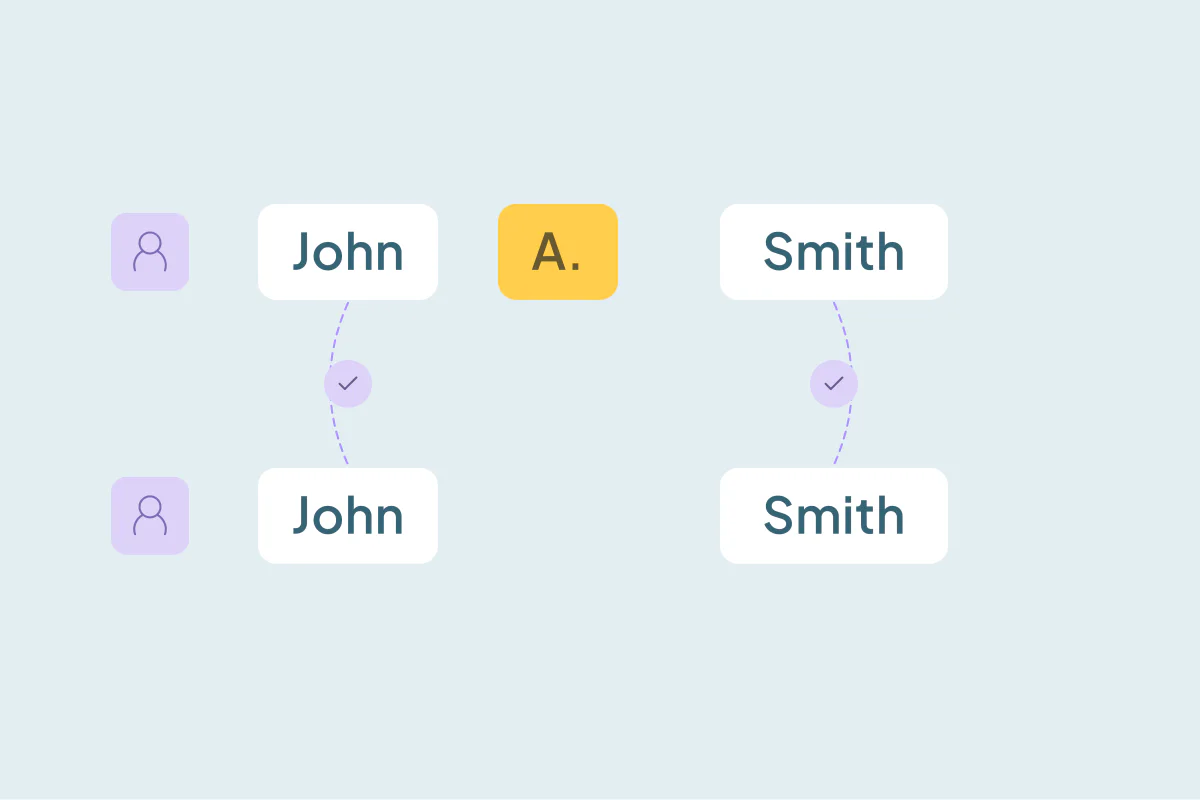
- "John A. Smith" and "John Smith" don't match exactly, so exact name searches miss them.
- Middle names land in the first name, last name or a full name field depending on the source.
- Comparing the words two names share catches most of these pairs.
- A middle initial can also be what tells a father and son apart, so check a second field.
- In Dedupely, Similar Words compares shared words in any order, with a set number of words to match.
One form asks for a full name and gets "John A. Smith." A rep types "John Smith." An import splits "John Andrew Smith" into a first name of "John Andrew." To an exact comparison, these are three different people.
Middle names and initials are a small difference that hides a lot of duplicates. This post covers where they end up in your CRM, how to match around them and when a middle initial is the only thing keeping two real people apart.
Where middle names end up
There's rarely a middle name field, so the middle name goes wherever the source puts it:
- In the first name field. "John A." or "John Andrew" as the first name, "Smith" as the last.
- In the last name field. "A. Smith" or "Andrew Smith" as the last name.
- In a full name field. "John A. Smith" as one value, from a tool that doesn't split names.
- Dropped. The same person entered as plain "John Smith" elsewhere.
The same person can appear in all four ways, depending on which form, import or rep created each record.
Why exact matching misses them
Exact matching compares the whole value. "John A." isn't "John," so a search on first name and last name treats the records as different. Fuzzy and phonetic matching don't help much either, because the extra word changes the value more than a typo would.
What works is comparing the words two names share instead of the whole value. "John A. Smith" and "John Smith" share "John" and "Smith." If a search only needs those two words to agree, the middle initial stops getting in the way.
How to match around middle names
Compare shared words in any order
Match the full name, or the first name field, on the words both values have in common. Set how many words need to agree. For a first name field, one shared word ("John") is usually enough, since the last name is matched separately.
Ignore the initial itself
Single letters and their periods add noise. Some teams standardize names first, moving middle names into their own field or removing initials. Do you need to standardize CRM data before deduplicating? covers when that's worth doing.
Add a second field
A looser name comparison finds more real duplicates, and also more people who simply share a name. Pair it with email, phone or company so a name alone can't create a match.
| Records | Match on | Why |
|---|---|---|
| "John A." / "John", same last name | Shared words in first name + exact last name + email | Catches the initial, email confirms the person |
| "John A. Smith" full name / "John" + "Smith" | Shared words in full name + phone | Works across name formats |
| "J. Smith" / "John Smith" | Review by hand | An initial alone can be John, Jane or Joseph |
When the middle initial matters
Sometimes the initial is the only difference between two people. A father and son with the same name, or two people at a large company, may be told apart only by "John A." and "John B."
Before merging pairs found through a looser name match, check whether the middle initials disagree. "John A. Smith" and "John Smith" can be one person. "John A. Smith" and "John B. Smith" usually aren't. When they're two people, reject the pair so it doesn't come back.
Keep the fuller name
When the records are the same person, decide which version of the name survives. Most teams keep the fullest version, with the middle name or initial, because it helps reps tell people apart later. Others prefer the version the person uses in email signatures. Either way, decide before merging in bulk, so the choice is the same for every record.
How to match names with middle initials in Dedupely
In Dedupely, the Similar Words match option compares the words two values share, in any order, and you set the number of words that need to match. You can add up to 50 ignored terms per field, for values you want left out of the comparison. Each field gets its own match option, so you can compare shared name words while requiring the same email or phone.
Merge Rules include best-name options that keep the complete, properly capitalized name instead of initials or placeholders. Pairs that turn out to be two people can be rejected, and they stay out of future searches.
A small difference with a big effect
A middle initial is enough to hide a duplicate from an exact name search. Comparing the words names share finds most of these pairs, and a second field like email or phone confirms them.
Watch for two different initials, which usually mean two people. Then keep the fullest name on the records you merge.
Frequently asked questions
Will "John A. Smith" and "John Smith" show up as duplicates?
Not with an exact name search, because the values differ. A search that compares the words two names share will match them.
Should I match on full name or on first and last name?
Use whatever fields your records have. If some sources write a full name and others split it, compare shared words in each field and confirm with email or phone.
Can a middle initial mean two different people?
Yes. Two different initials, like "John A." and "John B.," often mean two people, especially at large companies or family businesses. Review those pairs before merging.
Which name should I keep after merging?
Most teams keep the fullest version, with the middle name or initial, so reps can tell people apart. Decide before merging in bulk, so every merge follows the same choice.
Do I need to clean up names before deduplicating?
Not always. Comparing shared words handles most middle-name differences. Standardizing helps if your names are very inconsistent, for example with initials in the last name field.




 Or sign up with Google
 HubSpot Marketplace