

TL;DR
- Legal suffixes like Inc., LLC or GmbH make one company's name look different across records.
- An exact company name match treats "Fernhill" and "Fernhill Inc." as two companies.
- Compare company names by their shared words while ignoring legal suffixes.
- Matching the core website domain as well catches duplicate companies that names miss.
- With Dedupely, you can match company names while ignoring suffixes you add, like Inc. or GmbH.
A rep logs a call with "Fernhill." The finance sync brings in "Fernhill Logistics, Inc." A form adds "FERNHILL LOGISTICS INC" a week later. To a person, that's one company. To an exact name match, it's three.
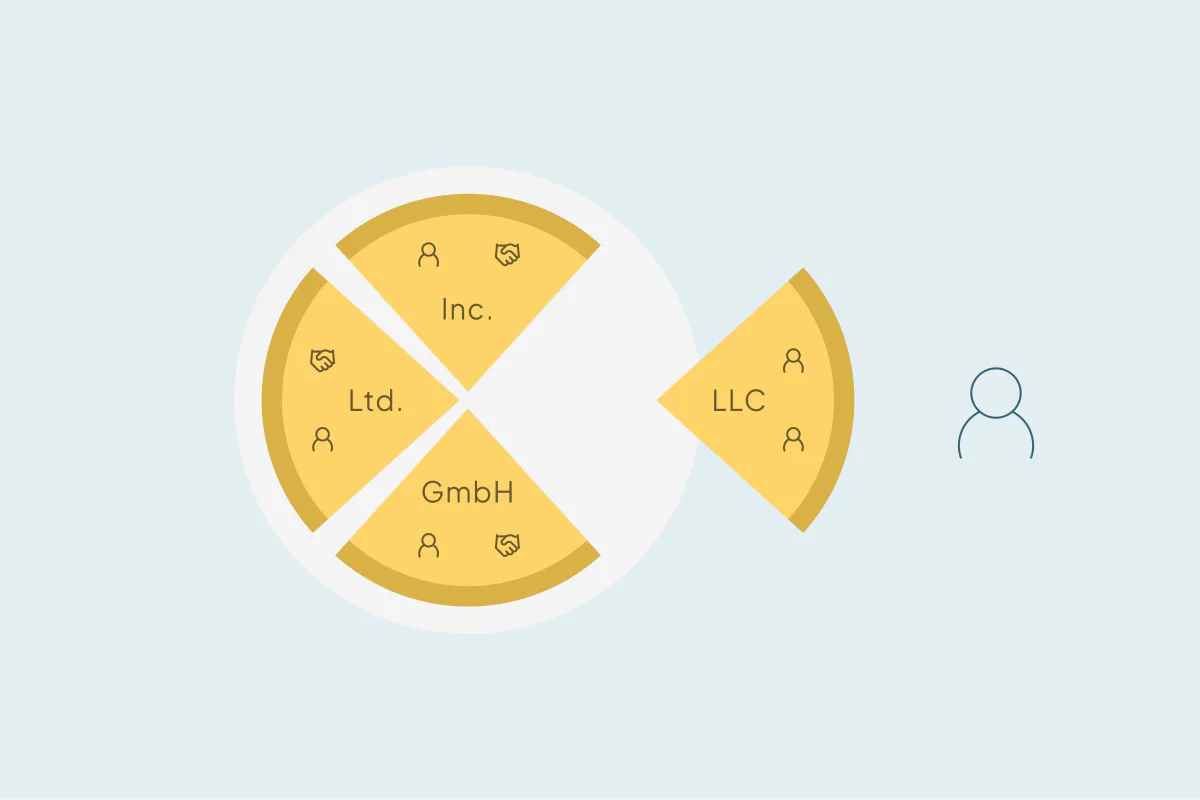
Legal suffixes are a frequent reason duplicate companies go unnoticed. They change from country to country, they're written with and without periods, and they're sometimes left out entirely.
In this post, you'll see where suffix variations come from and the common ones in nine countries. You'll also see how to match company names so suffixes stop hiding duplicates.
Why suffixes split one company into several records
The legal suffix tells you what kind of company it is, like a corporation or a limited liability company. It's part of the official name, but many people leave it out when they type.
That creates variation wherever records come from:
- Manual entry: reps type the name the way they say it, often without a suffix.
- Forms: people write their company name however they like, with or without the suffix.
- Enrichment and data providers: these often add the full legal name.
- Billing and finance tools: invoices need the legal name, so synced records carry it.
- Imports: lists from events or vendors follow whatever format their source used.
Even when everyone includes the suffix, it's written differently. "Inc", "Inc." and "Incorporated" are one suffix, and so are "Ltd" and "Limited". "S.r.l.", "Srl" and "SRL" are the same Italian form.
Common company suffixes by country
Here are common legal forms in nine countries, with the abbreviations you're likely to see in company names.
| Country | Common suffixes | What they stand for |
|---|---|---|
| United States | Inc., Corp., LLC | Incorporated; Corporation; Limited liability company |
| Germany | GmbH, AG, KG | Gesellschaft mit beschränkter Haftung; Aktiengesellschaft; Kommanditgesellschaft |
| United Kingdom | Ltd, PLC, LLP | Limited; Public limited company; Limited liability partnership |
| Italy | S.r.l., S.p.A. | Società a responsabilità limitata; Società per azioni |
| Portugal | Lda., S.A. | Sociedade por quotas; Sociedade anónima |
| Brazil | Ltda., S.A. | Sociedade limitada; Sociedade anônima |
| Sweden | AB, AB (publ) | Aktiebolag; Publikt aktiebolag |
| Spain | S.L., S.A. | Sociedad limitada; Sociedad anónima |
| Mexico | S.A. de C.V., S. de R.L. de C.V. | Sociedad anónima de capital variable; Sociedad de responsabilidad limitada de capital variable |
Sources: the GLEIF legal forms list, government and trade-agency pages, law-firm country guides and reference lists. Spelling varies, with and without periods or spaces.
The same suffix can also mean different things in different places. "S.A." appears in Spain, Portugal, Brazil and Mexico, so it says little on its own about where a company is.
Why exact name matching misses these duplicates
An exact match compares the whole value. "Fernhill GmbH" and "Fernhill" differ by one word, so they don't match, even though the part that names the company is identical.
Punctuation makes it worse. "Fernhill, Inc." with a comma, "Fernhill Inc" without a period and "FERNHILL INC." in capitals can all end up as separate records. Ignoring capitalization helps with the last one, but not with the rest.
Longer suffixes add more words. "S. de R.L. de C.V." can be five tokens, which can outweigh a short company name when you compare word by word.
Match the name and the domain together
A dependable approach uses two fields. Compare company names in a way that ignores suffixes, and compare website domains by their core. Each one covers the other's weak spots.
Compare names by their words, ignoring suffixes
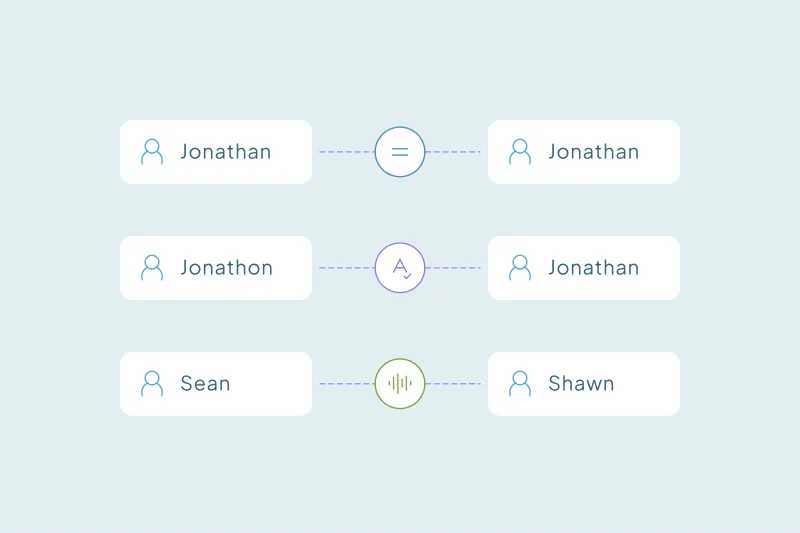
Compare the words two names share, and leave legal suffixes out of the comparison. "Fernhill Inc.", "Fernhill LLC" and "Fernhill" then all reduce to "Fernhill."
Start your ignore list with the suffixes in your own data. Other common words, like "Group", "Holding" or "The", can be worth ignoring too. Be careful, since "Fernhill Group" may be a different entity from "Fernhill".
Add the core domain
The website domain often stays the same however the name is written. Compare it by its core, ignoring "www", "https" and country endings, so fernhill.com and www.fernhill.de line up.
Why the pair works
A name match on its own can pair different businesses with similar names. A domain match on its own can pair branches or subsidiaries that share a website. When both agree, you can be much more confident the records are one company.
When only one agrees, look closer before merging. A record without a domain may still be a duplicate, and a shared domain may still belong to two separate entities.
When a different suffix means a different company
Ignoring suffixes finds duplicates, but sometimes the suffix is the only thing that tells two real companies apart. Whether they count as duplicates is case by case. What one team considers a duplicate, another may not.
- Entities in different countries: "Fernhill GmbH" and "Fernhill Inc." may be the German and US companies of one group. One team bills them separately; another sees one customer.
- Holding and operating companies: "Fernhill Holding AG" and "Fernhill AG" can be separate legal entities with separate contracts.
- A change of legal form: a company that converted from one form to another may appear under both names. Here, merging is often right.
Before you merge across suffixes, decide what your team counts as one company. If entities in different countries stay apart for your team, add country to the match.
How Dedupely matches company names across suffixes
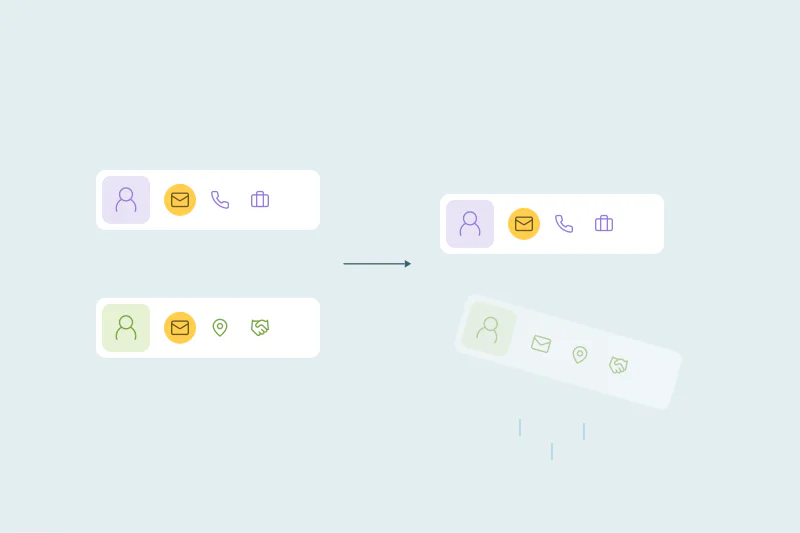
In Dedupely, you can match company names by the words they share while ignoring suffixes you add, like Inc. or GmbH. You can also match websites and email addresses by their core domain, ignoring www, .com and country endings. Combine both in one duplicate search, then preview each merge before anything changes in your CRM.
Look past the suffix
Legal suffixes are useful on an invoice and unhelpful in a duplicate search. They vary by country, by spelling and by whoever typed the record, so exact name matching keeps missing companies that are plainly the same.
Comparing names without their suffixes, together with the core domain, finds many of these duplicates. Deciding what your team counts as one company handles the rest, especially when a suffix is the only sign of a separate entity.
Frequently asked questions
How do you find duplicate companies with different suffixes like Inc. or LLC?
Compare company names by their shared words while ignoring legal suffixes, so "Fernhill Inc." and "Fernhill" match. Pair that with a match on the core website domain. When both agree, the records are very likely one company. When only one agrees, review the set before merging.
Should you remove Inc. and LLC from company names in your CRM?
Often there's no need. Finance, contracts and invoices often need the full legal name, so removing suffixes can cause problems elsewhere. It's safer to keep the name as it is and ignore the suffix only when matching records for duplicates.
What do company suffixes like GmbH, S.A. and Ltd mean?
They show a company's legal form. GmbH is a German limited liability company, Ltd is a UK private limited company, and S.A. is a corporation in Spain, Portugal, Brazil and other countries. Each country has its own set, written with or without periods.
Is matching on company name enough to find duplicate companies?
Company name alone often falls short: names vary with suffixes, punctuation and spelling, and different businesses can share a name. Match on name and core website domain together. Add country when entities in different countries should stay separate, and review sets where only one of the fields agrees.
Are two companies with the same name but different suffixes the same company?
Sometimes, depending on your team: "Fernhill" and "Fernhill Inc." are often one company typed two ways. "Fernhill GmbH" and "Fernhill Inc." may be separate entities in Germany and the US. Decide what counts as one company before merging across suffixes.



 Or sign up with Google