Customer story
How a Fintech Gave Its Sales Team a Pipeline It Can Trust by Clearing 4,000+ Duplicate Matches with Dedupely
- HubSpot
- Years of legacy data
- Financial services

- 2,158 company matches merged in under 7 weeks
- 1,852 deal matches merged in under 7 weeks
- 12 searches on Auto Merge
A match is one set of duplicate records merged into a single record. Every match holds at least two records, and many of these held three or more, so the number of records merged is more than double the number of matches.
Where duplicates came from
One company, two website fields, and a deal for every duplicate
The company is a fintech business that runs its sales pipeline in HubSpot, with more than 500,000 records and a couple of thousand deals. The RevOps manager had used Dedupely a couple of years earlier, moved away from it, and came back with what he described as a big duplicate problem at the company level and the deal level. He had already built searches and merge rules of his own, and duplicates were still getting through.
Three things kept creating them:
- The website lived in two places. Some company records stored it in the domain field, others in a second website field. A search on one field missed the duplicates hiding in the other.
- Company merges created deal duplicates. When two companies merged, each brought its own deal along, so the surviving company ended up with two deals in the same pipeline. Every company cleanup could leave a new deal cleanup behind.
- Not every record should match. Companies created from personal email domains, like Gmail or Yahoo, and companies that belong to a parent company had to stay out of the merge, or the wrong records would combine.

What duplicates broke
A weekly hunt for records that should have merged
When he came back, he said the duplicates were causing chaos. Nearly every week he would find records that should have merged and hadn't, and wonder why there were still so many duplicates.
On the deal side, a merged company could end up with two deals for the same client in the same pipeline, and someone had to find and merge them by hand. The team had already decided which deal stages should survive a merge, with stages like Lost or Bad lead set to lose.
Why loose rules were risky
Matching on too little was risky at this scale. Early on, an automated company search merged two companies whose domains matched except for the ending. Domain Root ignores www, .com and country variants by design, so the search did what it was set up to do. He wasn't worried about that pair, but he paused the search's Auto Merge and added a second check, so two companies that really are different couldn't merge the same way.
Matching on too much missed real duplicates instead. A search that required both the domain and the website field skipped pairs where one record left the website blank, because blank values don't count as a match.
How duplicates were solved
-
1. Bring in the fields the searches need
The first fix was bringing in the right fields. With Dedupely's customer success team, he added the second website field to company searches, and the associated company's name and website to deal searches, then waited for the resync so the new fields showed up in the results. Every merge Dedupely makes is also recorded in Merge History, which the team exported as a CSV backup.
-
2. Match companies on the domain, with guardrails
Company searches match on Domain Root, which compares the core domain and ignores www, .com and country variants. To keep different companies apart, he added a second field, country or region, so a match needs the same domain and the same country.
Filters keep the wrong records out before matching starts. One filter drops companies with personal email domains like Gmail, Yahoo and Proton. Another keeps out companies that have a parent company. More match fields mean fewer results, but more solid duplicates.
-
3. Give deals their own search and their own rules
Deals match on the associated company and the pipeline, so two deals only merge when they belong to the same client in the same pipeline. That catches exactly the pair a company merge leaves behind.
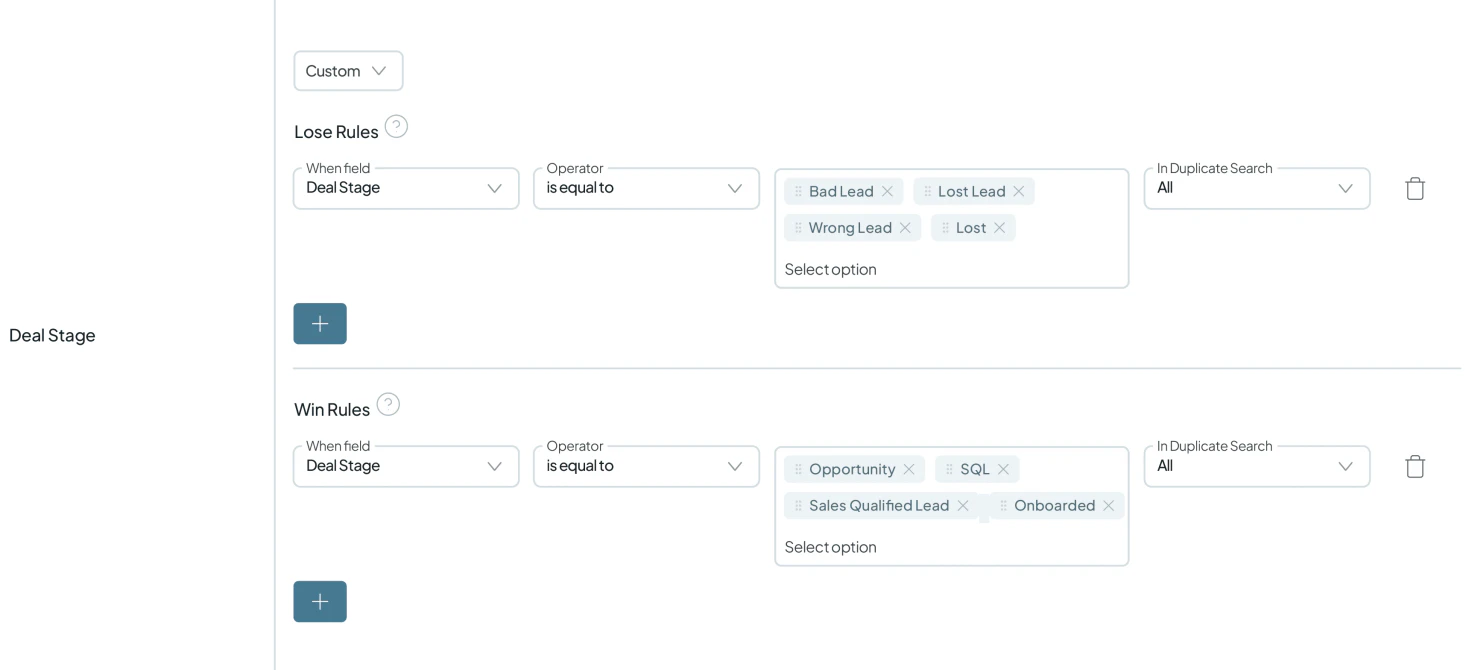
Merge Rules decide what survives. For deals, the Primary Record is the oldest deal, so a merge always keeps the deal that was created first. On deal stage, Lose Rules make stages like Leads, Bad lead and Lost lose, and Win Rules favor stages that show real progress, such as qualified leads, opportunities and onboarded customers. Lose Rules always run before Win Rules, and blank fields never overwrite existing data.
-
4. Automate on a schedule, then keep an eye on it
Once a search returned only real duplicates, he turned on Auto Merge, which merges new duplicates on a schedule using the search's criteria and its Merge Rules. Company searches that had been running every few minutes moved to a daily schedule, and deal searches run on set days. When he set up Auto Merge on a new deal search, he planned to review its results closely before leaving it on.
Rejecting matches made that safer. When a pair isn't a real duplicate, he rejects it, and it drops out of current and future searches, so it never gets merged by mistake.
What deduplication changed
Searches that run themselves
Within a few weeks he was merging so much that he had stopped keeping count. Soon after, his main automated company search was doing its job, catching most duplicates and only occasionally flagging a real edge case, so he left it running. An older one-off search now returned nothing at all, most likely because its duplicates had already been merged.
The numbers back that up. In under 7 weeks, the team merged 2,158 company matches and 1,852 deal matches, many of them with three or more records in a single match. Twelve searches now run on Auto Merge, so new duplicates across companies and deals merge on a schedule instead of waiting for someone to spot them.
A tool the team kept building on
He described Dedupely as doing a great job deduplicating their records, and the team kept adding to the setup: separate searches for companies and deals, Merge Rules for each object, and filters that keep the wrong records out.
Related

- Customer story 140,000+ duplicate records mergedSalesforce Healthcare
How a Healthcare Software Company Stopped Cleaning the Same Duplicates Twice in HubSpot and Salesforce with Dedupely
Read the story - Customer story 58,000+ duplicate records mergedPipedrive SaaS
How a SaaS Company Merged 58,000+ Duplicate Pipedrive Records Created by Its Migration from HubSpot, with Dedupely
Read the story - Customer story 20,000+ duplicate records mergedPipedrive SaaS
How an AI Phone Answering Company Stopped Hand-Checking Pipedrive and Merged 20,000+ Duplicate Records with Dedupely
Read the story














