Lead lists arrive from trade shows, webinars, vendor buys and partner referrals, and each one carries part of the same contact. Blending them into one row per person before the upload is what keeps the records you already have intact.
Existing Limitations of Native Spreadsheet Deduping
Spreadsheets handle exact match row deletions well, but struggle with partial match row logic. If Row A contains a direct phone number and Row B contains an updated title, native deduplication simply deletes one entire row and discards valid data.
Formula-based methods like VLOOKUP or conditional formatting across multiple files are fragile, slow down significantly on large datasets, and introduce human error during manual copy-pasting. Furthermore, standard spreadsheets cannot validate dropdown strings against live CRM picklists, leaving invalid values that trigger rejected rows during upload.
The Main Reasons You Need to Import Spreadsheets to Your CRM
Legacy Data
Legacy data consists of historical archives from deprecated software, acquired customer bases, or old sales databases. Uploading legacy files as-is forces outdated column structures onto your CRM, bypasses validation rules, and overwrites enriched current records with stale data.
Multi-Source Incoming Data
Multi-source data includes recurring lead lists coming from trade show registrations, co-hosted webinars, vendor prospect buys, and partner referrals. Frequently uploading raw files from different channels creates duplicate contact entries, splits target accounts across different sales reps, and triggers duplicate automated campaign emails.
Why You Should Clean and Blend Spreadsheets
Core Wins
- Complete field retention by merging scattered details across files into one master row per contact
- Error-free import logs with zero rejected rows or failed property mappings
- Reliable attribution data and accurate pipeline metrics that leadership can trust
- High sales team trust in lead assignments and territory boundaries
Issues You'll Avoid
- Blind overwrites of enriched CRM data by blank spreadsheet cells
- Duplicate task creation and conflicting outreach by competing sales reps
- High unsubscribe rates caused by contacts receiving redundant email sequences
- Dozens of hours spent manually merging record pairs line-by-line inside the CRM post-import
How to prepare spreadsheets for a CRM import with Dedupely
- Align the columns
Keep copies of the source files. Give equivalent columns the same header and check formats and allowed values against the CRM's import requirements.
- Resolve conflicting values
Compare overlapping rows with the source files. Choose which values to keep and preserve any needed details before removing rows; removing duplicates alone does not resolve field conflicts.
- Combine the lists
Open the List Merger tool, upload two CSV files, and choose the columns used to identify overlapping rows. Check the combined output before downloading it.
- Check for remaining duplicates
Upload the combined CSV to CSV Dedupe, choose the identifying columns, and inspect the results. Download the cleaned file and compare it with the source copies.
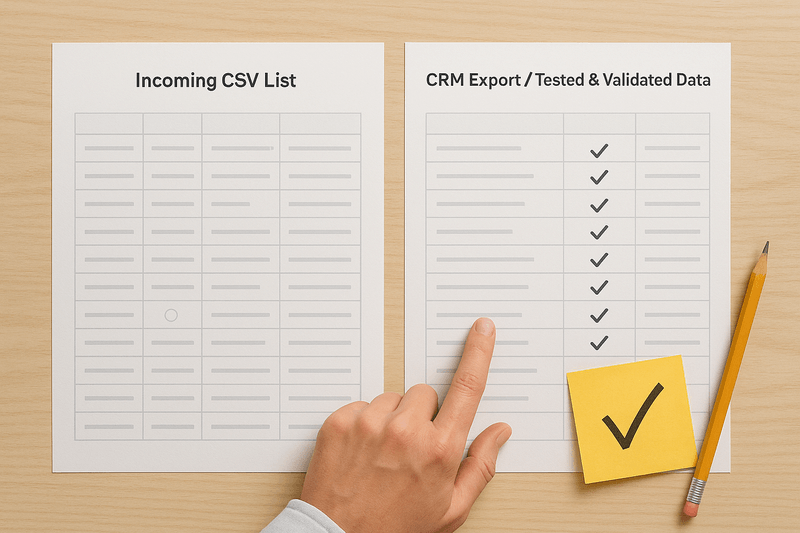
- Test the CRM import
Map the columns in your CRM's importer and test a small sample. Verify record updates, required fields, and associations before importing the rest.
Standardizing Repeatable Match and Merge Logic
Define fixed matching criteria and field winning logic for recurring list types. Establishing a set operational template eliminates the need to reinvent your deduplication process every time a new event or vendor list arrives.
Managing incoming files will always be part of revenue operations, but preparing spreadsheets shouldn't require endless manual effort or threaten database health. By establishing a clear pre-import workflow that standardizes headers and consolidates duplicate rows before upload, teams protect their production database and keep their systems running smoothly at scale.
Dedupely's free CSV tools merge two lists, dedupe the result and normalize the columns in the browser, before the file reaches your CRM.
Start free, connect your CRM, and see the duplicates you have before you merge anything. Start here.





 Or sign up with Google
 HubSpot Marketplace