 Dedupely Intelligence




TL;DR
- A LinkedIn profile URL belongs to one person and doesn't change when they change jobs or emails.
- That makes it one of the best fields for finding the same person with two different emails.
- The catch: the same URL gets saved in different forms, with or without https, www or a trailing slash.
- Exact matching misses those variants; a match on the profile path catches them.
- Dedupely Intelligence compares LinkedIn URLs by the profile path, so https, www and slashes don't matter.
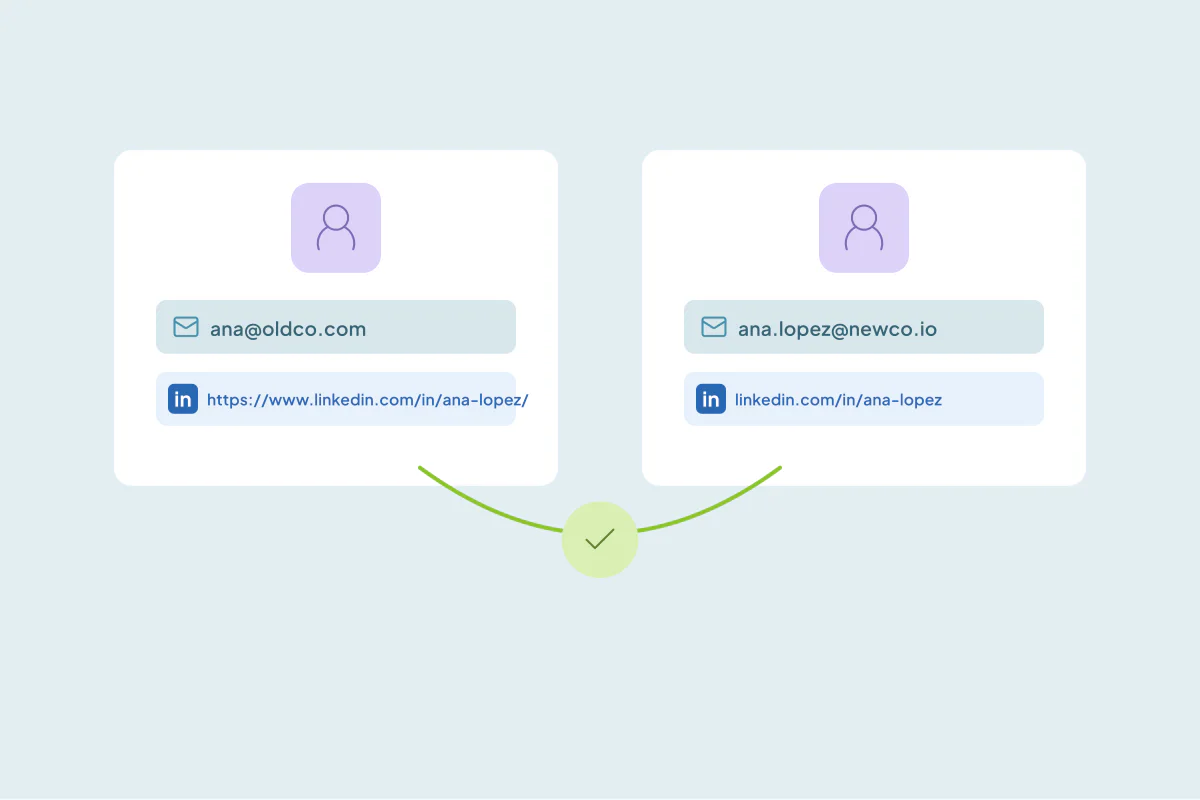
Some of the hardest duplicates to find are the same person with two different emails: a work email from their old job and a new one, or a personal and a work address. Name matching alone is risky, and email matching misses them by design.
If your CRM stores LinkedIn profile URLs, you have a better field. A profile URL belongs to one person and stays the same through job changes. This post covers how to match on it, and the formatting problem that gets in the way.
Why a LinkedIn URL is a strong match field
| Field | Changes when the person changes jobs? | Shared with other people? |
|---|---|---|
| Work email | Yes | Sometimes (shared inboxes) |
| Phone | Often | Sometimes (office lines) |
| Name | No | Yes, often |
| LinkedIn profile URL | No | No |
A profile URL works like an ID for the person. Two records with the same URL are almost always the same person, even when every other field differs.
Where the URLs come from
- Sales tools and browser extensions that add contacts from LinkedIn.
- Enrichment tools that fill in a profile URL.
- Forms that ask for it.
- Reps who paste it by hand.
Each source saves it a little differently.
The formatting problem
The same profile can be stored as:
- https://www.linkedin.com/in/ana-lopez/
- https://linkedin.com/in/ana-lopez
- linkedin.com/in/ana-lopez
- www.linkedin.com/in/ana-lopez/
To a person, these are the same. To an exact comparison, they're four different values. So an exact match on the LinkedIn field misses many of the duplicates it should find.
Matching on the domain doesn't help either: every LinkedIn URL shares linkedin.com, so a domain match would pair every contact who has a profile.
How to match on it
- Match on the profile path, the part after linkedin.com/in/, so prefixes and trailing slashes don't block the match.
- Pair it with a name field for a first pass, and review a sample before bulk merging.
- Leave out blank URLs, so records without a profile don't group together.
- Keep the newest email when you merge, and the old one as a secondary email if your CRM allows it.
How Dedupely matches LinkedIn URLs
In Dedupely, you can match on any synced field, including a LinkedIn profile URL field. Dedupely Intelligence compares LinkedIn URLs by the profile path, so the same profile matches with or without https, www or a trailing slash. In a Duplicate Search, Similar ignores case and punctuation, so a trailing slash doesn't block a match, but a missing https or www still does. Two blank values never match, so contacts without a URL don't group together. Merge Rules decide which email and owner survive, for example "Newest wins" on email.
One profile, one person
A LinkedIn profile URL is one of the most reliable ways to spot the same person behind two emails. Match it with an option that handles formatting differences, keep blanks out, pair it with a name for the first pass and review before merging.
Frequently asked questions
Can I find duplicate contacts by LinkedIn URL?
Yes. A profile URL belongs to one person, so two records with the same URL are almost always the same person.
Why doesn't an exact match on LinkedIn URL find all duplicates?
The same URL is saved in different forms, with or without https, www or a trailing slash. An exact comparison treats those as different.
Can I match on the domain of the LinkedIn URL?
No. Every LinkedIn URL shares the same domain, so a domain match would pair everyone with a profile.
Which match option should I use in Dedupely?
Dedupely Intelligence, which compares LinkedIn URLs by the profile path. In a Duplicate Search, Similar handles case and trailing slashes, but not a missing https or www.
What about company LinkedIn pages?
Keep them out of contact matching. A company page is shared by everyone who works there.


 Or sign up with Google

 HubSpot Marketplace